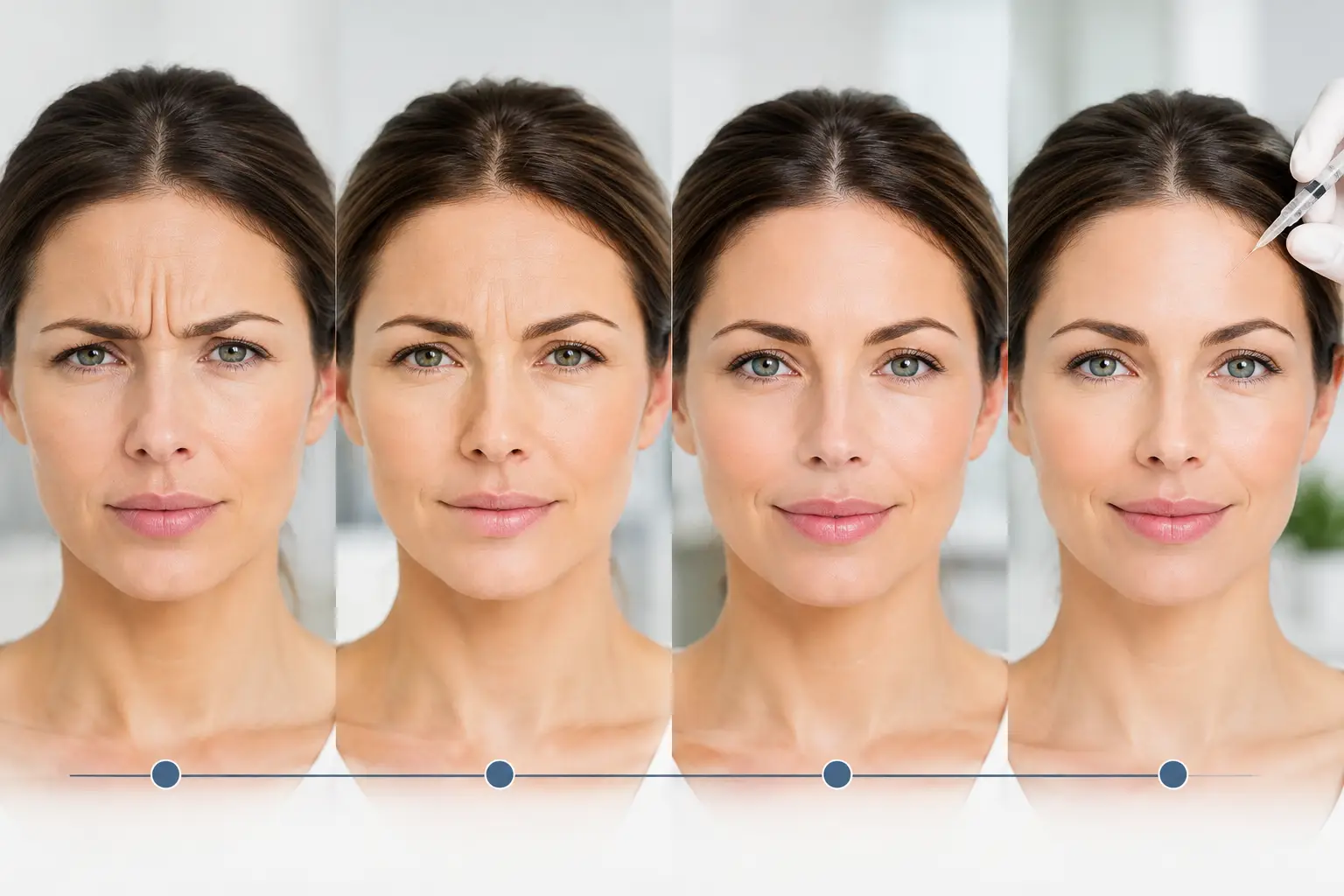
A smoother forehead does not usually happen the moment you leave your appointment. Understanding when Botox works helps you plan around an event, recognize normal progress, and avoid judging your treatment too soon. For most patients, the change begins gradually within a few days, with the most polished result appearing around two weeks.
Botox Cosmetic is designed to relax selected facial muscles that repeatedly crease the skin. It is one of the most effective non-surgical treatments for expression lines, but timing, technique, muscle strength, and your individual anatomy all influence what you see in the mirror.
When Botox Works After Your Appointment
Most people notice the first signs of movement softening within three to five days. The treated area may feel slightly less active before the visible lines begin to look smoother. By days seven through 10, many patients see a clear difference. Full results are typically assessed at about 10 to 14 days.
That two-week window matters. Botox does not fill a wrinkle the way dermal filler can. It reduces the muscle activity that folds the skin, allowing the area to rest. A line that is visible only when you frown, raise your brows, or squint often improves quickly. A deeper line that remains visible when your face is relaxed may soften substantially, but it can take repeated treatments or a complementary skin-rejuvenation plan to improve its appearance further.
If you are booking before a wedding, vacation, reunion, or professional photo session, schedule your treatment at least two weeks ahead. If it is your first time receiving Botox, allowing three to four weeks gives your provider time to evaluate the result and, when appropriate, make a small adjustment.
Why Botox Results Are Not the Same for Everyone
The timeline is predictable, but the final look is personal. An experienced injector does not simply place a standard number of units in every face. Your facial expressions, brow position, muscle movement, skin quality, and goals should guide the treatment plan.
A patient with strong forehead movement may need a different approach than someone seeking a very subtle softening of fine lines. Some people want a smooth, low-movement appearance. Others want to preserve a noticeable amount of expression. Neither goal is automatically better. The right result is one that looks refreshed, balanced, and appropriate for your features.
Treatment area also makes a difference. Frown lines between the brows, horizontal forehead lines, and crow's feet are common areas for Botox Cosmetic. Each region has different muscles and requires careful placement. The forehead, in particular, must be evaluated in relation to the brows. Over-treating or treating without a full facial assessment can create an unnatural result rather than the relaxed, rested look most patients want.
Metabolism can affect how long Botox lasts, although it does not usually change the initial two-week timeline dramatically. People who exercise intensely, have very strong facial muscles, or process neuromodulators more quickly may notice that results fade sooner. Others maintain a smooth appearance longer.
How Long Botox Usually Lasts
For many patients, Botox results last about three to four months. Movement returns gradually, not all at once. You may first notice that you can make a stronger expression again, followed by the gradual return of dynamic lines.
Consistency can help. Patients who return for treatment on a regular schedule may find that the muscles become less forceful over time, allowing them to maintain their preferred look with a personalized maintenance plan. That does not mean everyone needs the same appointment interval. Your provider should recommend timing based on your response, not pressure you into a one-size-fits-all schedule.
Waiting until all movement and every line has fully returned is not necessarily harmful, but it can make it harder to maintain a consistently smooth result. On the other hand, treating too frequently is not the goal either. A well-planned schedule respects both safety and natural facial expression.
What to Expect During the First 14 Days
Immediately after Botox, small raised areas at the injection sites can appear. These commonly resolve quickly. Mild redness, tenderness, or a small bruise is also possible, especially in sensitive skin or patients prone to bruising. These effects are generally temporary, but they are worth considering if you have an important event the same day.
Follow the aftercare guidance provided by your injector. Patients are commonly advised to avoid rubbing or massaging the treated areas and to follow instructions about exercise, makeup, and other activities after the appointment. Your specific recommendations may vary according to the areas treated and your health history.
The most common mistake is checking your face repeatedly during the first 48 hours and deciding nothing happened. Botox needs time to affect communication between the nerve and the targeted muscle. Take photos before treatment and again at the two-week mark in similar lighting, with your face both relaxed and animated. This gives you a more accurate comparison than relying on memory alone.
A touch-up is not always needed
A two-week follow-up can be useful, especially for new patients or for areas with unevenly strong muscles. However, a touch-up should be based on a professional assessment, not the expectation that every appointment requires more product. The best injectable results are often conservative, precise, and built over time.
When Botox May Not Be the Complete Answer
Botox is excellent for dynamic wrinkles, meaning lines caused primarily by facial movement. It is not a universal solution for every sign of aging. Loose skin, volume loss, sun damage, rough texture, enlarged pores, and deep etched-in lines may require a different treatment or a combination approach.
For example, a forehead line that is present at rest may improve with Botox because the skin gets a break from repeated folding. But if the crease is deeply established, treatments that support collagen and skin quality may also be recommended. Likewise, Botox can soften crow's feet, yet it will not replace lost volume in the cheeks or correct significant skin laxity.
This is why a consultation matters. A trained injector can explain what Botox is likely to improve, what it may improve only partially, and whether another non-surgical option may better support your goal. Clear expectations protect you from chasing an overdone result and help ensure you invest in the treatment that fits your face.
Safety Starts With the Right Injector
Botox is a medical treatment, not a casual beauty service. Results depend on facial anatomy, product handling, dosage, injection depth, and clinical judgment. Choosing a qualified provider in a medically supervised setting is essential for both safety and appearance.
During your consultation, disclose medications, supplements, allergies, prior injectable treatments, neurological conditions, and any history of facial surgery or eyelid concerns. Your provider should also discuss whether treatment is appropriate if you are pregnant, breastfeeding, or managing a condition that could affect your care. Never minimize health information in the interest of getting an appointment quickly.
Seek prompt medical guidance if you experience concerning or unexpected symptoms after treatment. While serious complications are uncommon when injections are performed appropriately, honest communication and proper follow-up are part of responsible aesthetic care.
Getting Results That Still Look Like You
The strongest Botox result is rarely the one that makes your face look frozen. It is the one people notice without immediately identifying why you look more rested. Natural-looking treatment respects the way your face moves while reducing the expressions that make you look tired, tense, or older than you feel.
At Elite Laser Center, Botox planning is centered on your goals, your facial anatomy, and the level of movement you want to keep. Whether you are considering injectables for the first time or refining a maintenance routine, a personalized consultation gives you a realistic timeline and a plan built for visible, confident results.
Give Botox the full two weeks to show its work, then evaluate the change with a trained eye. The right treatment should not erase your personality. It should let your confidence show up first.