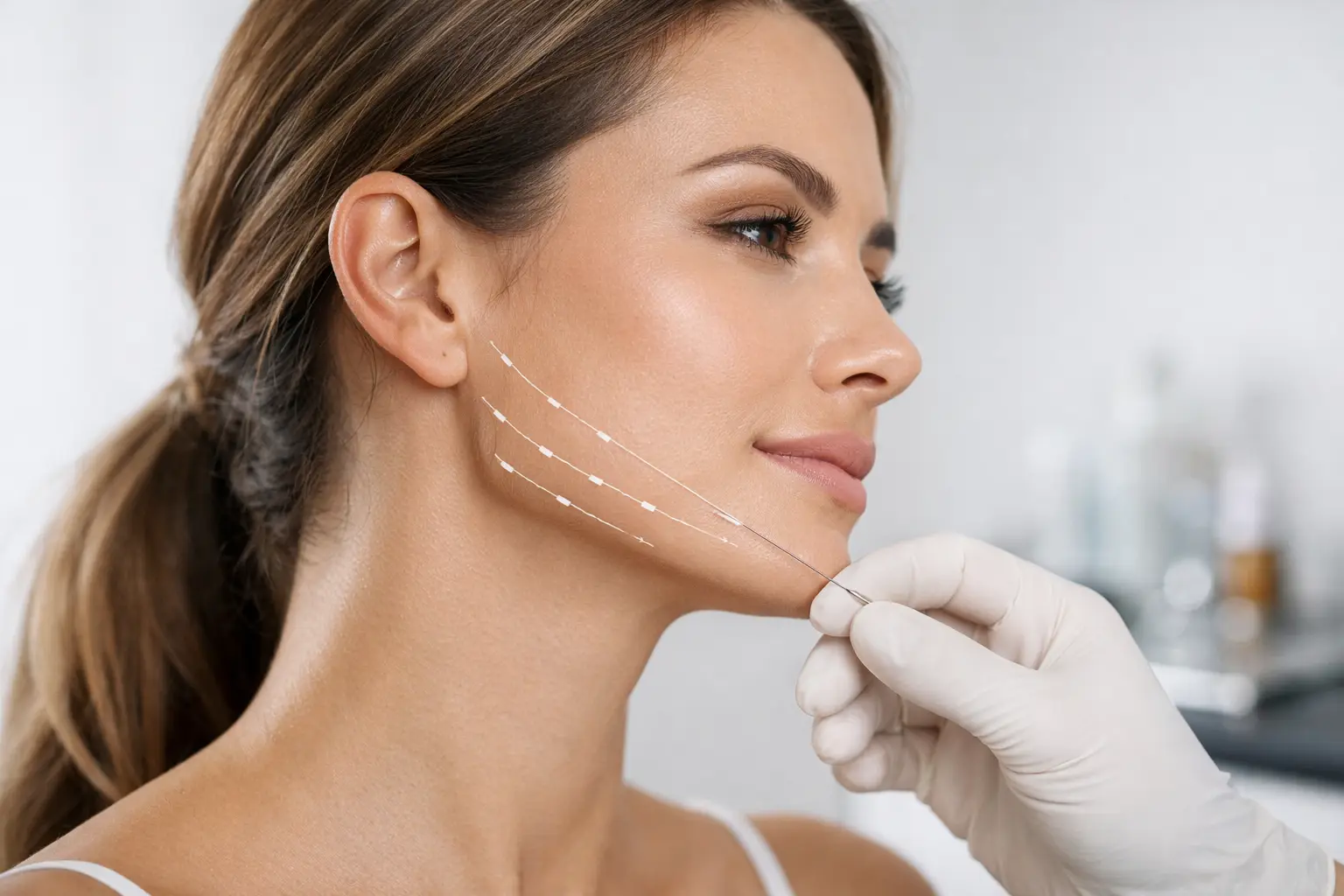
A softer jawline can make the whole lower face look less defined, even when skin quality is otherwise strong. Thread lift jawline results are designed to address this early-to-moderate laxity without the scars, anesthesia, or extended recovery of a surgical facelift. For the right candidate, strategically placed PDO or MINT threads can create a more lifted jawline, improve the appearance of early jowls, and restore sharper facial balance.
The key is having realistic expectations. A thread lift is a precision treatment, not a replacement for surgery. Results can be beautifully natural when the skin, tissue laxity, facial anatomy, and treatment plan are all a good match.
What Do Thread Lift Jawline Results Look Like?
Immediately after treatment, many clients notice a visible lifting effect along the jawline and lower cheeks. The face may look more supported, the transition from chin to jaw can appear cleaner, and mild jowling may be less noticeable. There can also be temporary swelling, tenderness, or slight unevenness in the first days, so the initial appearance is not always the final one.
Over the following weeks, the threads settle and the tissue adapts to its new position. PDO threads gradually encourage collagen production as they dissolve, helping support skin quality and firmness over time. MINT threads use a molded, barbed design intended to create strong anchoring and lifting support in appropriate areas of the face.
The best thread lift jawline results do not look pulled or overdone. They look like a rested, more defined version of your own face. Friends may notice that you look refreshed without being able to identify exactly why.
Your Results Timeline: Day One to Long-Term Support
A thread lift is often chosen by people who want meaningful improvement with limited downtime. Still, this is not a treatment to schedule the day before a major event.
During the first 24 to 72 hours, expect some swelling, soreness, tightness, and occasional bruising. Small entry points may be visible initially. Some clients also feel a mild pulling sensation when smiling, chewing, or moving their face. These effects are usually temporary and should be discussed with your provider if they feel severe or worsen.
By one to two weeks, most visible swelling and bruising have improved. The jawline begins to look more natural as the threads settle. At about four to eight weeks, the collagen-stimulating benefits become more apparent, and many clients see their most polished early result during this period.
Longevity varies. A lifted appearance commonly lasts about 12 to 18 months, although individual results can be shorter or longer. Your age, skin elasticity, metabolism, the number and type of threads used, and daily habits all play a role. The collagen response may provide ongoing skin-quality benefits after the thread material has dissolved, but it will not stop the natural aging process.
Who Gets the Best Jawline Thread Lift Results?
Thread lifts tend to perform best for adults with mild to moderate skin laxity who still have good skin thickness and enough structural support in the lower face. They are often a strong option for someone beginning to see jowls, loss of jawline sharpness, or mild descent in the cheeks but who is not ready for a surgical procedure.
A client in their late 30s, 40s, or early 50s with early laxity may see a noticeable improvement. Some clients in their 60s can also be good candidates, but the decision depends far more on tissue quality than a number on a birthday cake.
A thread lift may not be the best standalone solution when there is significant loose skin, heavy jowling, substantial volume loss, or a large amount of fullness beneath the chin. In those situations, a surgical consultation or a combined nonsurgical plan may produce a more satisfying outcome. An honest consultation protects you from investing in a treatment that cannot realistically meet your goals.
What Affects How Defined Your Jawline Will Be?
Thread placement matters as much as thread type. An experienced provider evaluates where laxity begins, how the cheeks are contributing to lower-face heaviness, the condition of the skin, and the balance between the chin, jaw, and neck. Simply pulling skin tighter is not the goal. The goal is to restore support in a way that respects your natural facial proportions.
Your skin quality is another major factor. Healthy collagen, consistent sun protection, a stable weight, and an appropriate skincare routine can help preserve results. Smoking can compromise healing and collagen production, which is why it should be disclosed during your consultation. Significant weight fluctuation can also change the appearance of the lower face after treatment.
The choice between PDO and MINT threads depends on your needs. PDO threads can support collagen stimulation and subtle lifting, while MINT threads may be recommended when stronger mechanical lift is appropriate. Neither option is automatically better for every client. Your provider should explain why a specific thread, placement pattern, and number of threads is being recommended.
Can Threads Be Combined With Other Jawline Treatments?
Often, yes. The most natural-looking results frequently come from treating the cause of the concern rather than using one treatment for every issue.
For example, small amounts of filler may improve chin projection or facial balance when a recessed chin makes the jawline appear less defined. Neuromodulator injections can help relax the masseter muscles for clients whose lower face looks wide due to muscle activity. Skin tightening treatments may complement threads when crepey texture or mild laxity is also present. If fullness under the chin is the concern, a body contouring or injectable fat-reduction option may be discussed instead of, or alongside, lifting.
Combination treatment should be planned carefully. More treatment is not always better. The right approach is the one that addresses your anatomy, respects recovery time, and maintains a believable result.
Safety, Downtime, and What to Ask at Your Consultation
Thread lifts should be performed in a medically supervised setting by a qualified, experienced provider who understands facial anatomy and can manage complications if they occur. Although nonsurgical, this is still a medical aesthetic procedure.
Potential side effects include bruising, swelling, tenderness, temporary puckering or dimpling, asymmetry, infection, thread visibility, and thread migration. Serious complications are uncommon but possible. This is why a thorough assessment, sterile technique, proper placement, and clear aftercare instructions matter.
Before treatment, ask what type of threads will be used, where they will be placed, how many may be needed, what downtime is expected, and what results are realistic for your face. You should also disclose medications, supplements, allergies, prior cosmetic procedures, autoimmune conditions, active skin infections, and any history of poor wound healing.
After a jawline thread lift, clients are commonly advised to avoid strenuous exercise, aggressive facial massage, dental work, wide mouth movements, and sleeping on the side for a period recommended by their provider. Follow those instructions closely. Good aftercare helps protect the positioning of the threads while the tissue heals.
Choosing a Provider for Results That Still Look Like You
Price matters, but it should not be the only decision point for a procedure that involves your face. Look for medical oversight, hands-on experience with PDO and MINT threads, a personalized treatment plan, and a provider who is willing to say when threads are not your best option. Before-and-after photos should show refined improvement, not an exaggerated or identical result on every face.
At Elite Laser Center, a personalized consultation can help determine whether a thread lift, skin tightening, injectables, or a combination plan is the right path toward your jawline goals. The most rewarding result is not a dramatic change for its own sake. It is a confident, naturally defined profile that fits your features and your life.