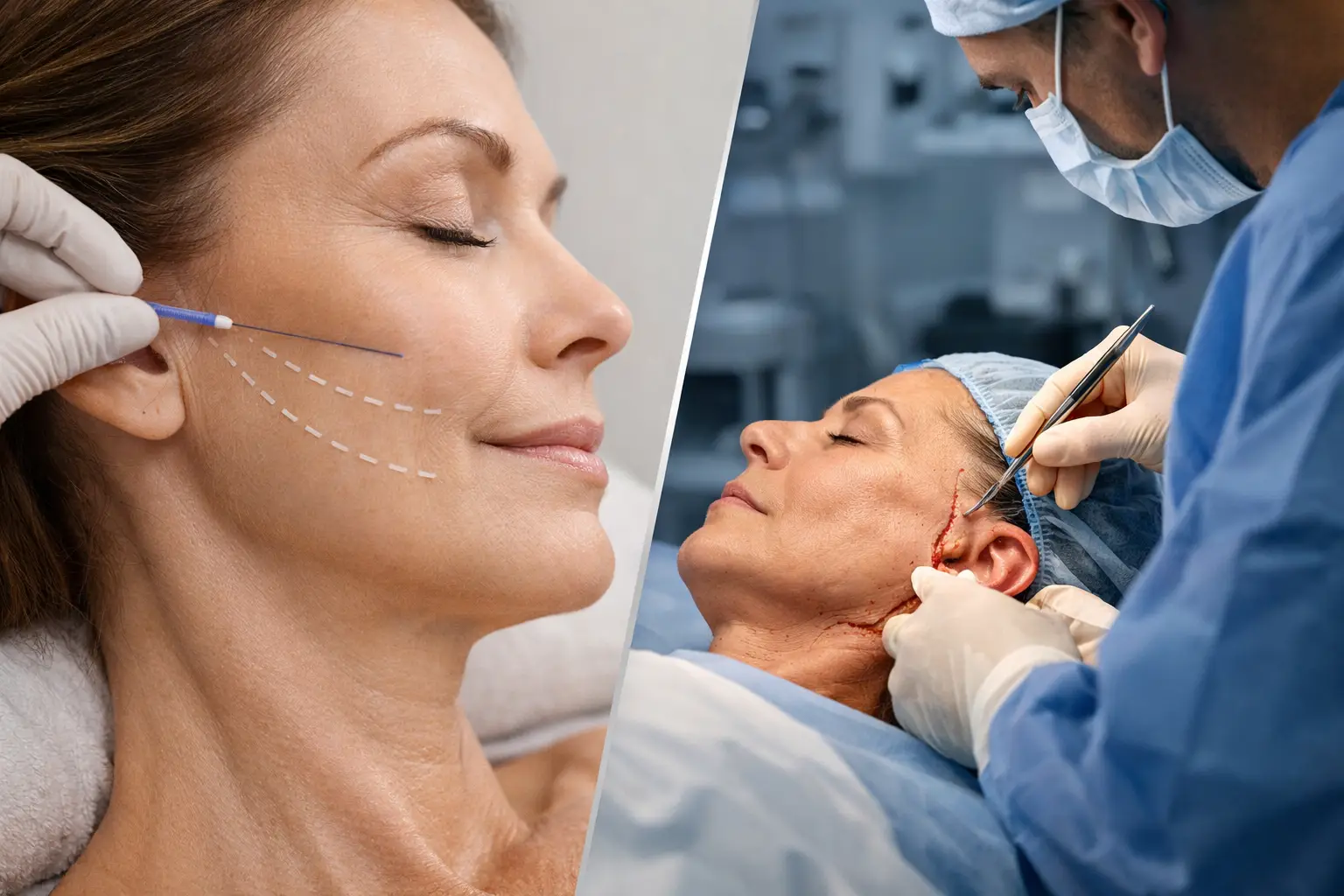
A softer jawline, deeper smile lines, and skin that no longer sits as firmly along the cheeks can make a person feel less like themselves in photos and the mirror. When comparing PDO threads vs facelift, the real question is not which treatment is “better.” It is which option matches the degree of laxity, the result you want, and the amount of downtime you are willing to take.
PDO threads offer a non-surgical way to create a subtle lift and support collagen production with far less recovery than surgery. A facelift delivers the most dramatic and longest-lasting correction for more advanced aging, but it requires an operation and a substantially bigger commitment. Understanding that difference helps you invest in a treatment that looks natural and makes sense for your lifestyle.
PDO Threads vs Facelift: The Core Difference
PDO thread lifting is a minimally invasive treatment that uses absorbable sutures placed beneath the skin. Depending on the treatment plan, smooth threads may be used to encourage collagen or barbed lifting threads, including advanced options such as MINT threads, may be used to reposition mildly lax tissue. The goal is a refreshed, more defined appearance without surgical incisions or general anesthesia.
A surgical facelift, also called a rhytidectomy, involves incisions that allow a plastic surgeon to lift and reposition deeper facial tissues and remove or redrape excess skin. It can address significant jowling, loose neck skin, deep folds, and more pronounced midface descent in ways threads cannot.
Neither choice is a shortcut to the other. Threads are not a non-surgical facelift, and a facelift is not necessary simply because someone notices early signs of aging. The best option depends on what is happening beneath the skin, not just on a patient’s age.
What Results Can PDO Threads Deliver?
For the right candidate, PDO threads can create a visible but understated improvement in areas that have begun to lose definition. Common treatment areas include the cheeks, jawline, lower face, brows, and neck. Results are intended to look like a fresher version of you, not a sudden, overdone change.
The initial lift may be apparent shortly after treatment, although swelling can temporarily affect how the area looks. Improvement continues as the threads stimulate the body’s collagen response. The threads gradually dissolve, but the collagen support they encourage can help maintain a firmer appearance over time.
Most people who choose PDO threads have mild to moderate skin laxity, good skin quality, and realistic expectations. They may want a more defined jawline before a milestone event, notice early jowls, or prefer to postpone surgery while maintaining their appearance with non-surgical treatments.
PDO threads are especially appealing to busy Long Island patients because treatment is typically performed in-office and does not require the extended recovery associated with surgery. That said, “minimal downtime” does not mean no aftercare. Bruising, tenderness, swelling, puckering, or tightness can occur, particularly during the first several days. Patients are usually advised to avoid strenuous exercise, aggressive facial massage, wide mouth movements, and certain dental work for a period recommended by their provider.
What a Facelift Can Do That Threads Cannot
A facelift is designed for more substantial correction. It can reposition deeper structures, improve significant jowls, sharpen the jawline, address loose skin through the lower face, and often improve the neck when combined with a neck lift. For someone with extensive skin laxity or heavy tissue descent, this level of correction may be the only way to achieve the result they have in mind.
The trade-off is clear: surgery involves incisions, anesthesia or sedation, recovery time, and surgical risks. Bruising and swelling can last weeks, and patients need to plan for time away from social events, work, and exercise. Scars are placed carefully, but scar management and healing are part of the process.
A well-performed facelift can deliver results that last many years. It does not stop the aging process, but it can reset the clock more dramatically than non-surgical treatments. Patients who want a major correction and are comfortable with surgery may find that a facelift offers stronger value than repeating temporary treatments that cannot reach their desired level of lift.
Comparing Recovery, Longevity, and Investment
PDO threads are generally a shorter appointment with a shorter recovery period. Many patients return to routine activities quickly, though they should expect to follow post-treatment restrictions and allow bruising or swelling to settle. Results commonly last about one to two years, with longevity influenced by the thread type, treatment area, skin condition, lifestyle, metabolism, and facial movement.
Facelift recovery is longer and more involved, but results usually last much longer. Cost also reflects the difference in procedure complexity. Thread lifting is typically less expensive upfront than surgery. However, it may require maintenance treatments over the years. A facelift requires a larger initial investment but may be more cost-effective for someone seeking a significant, durable change.
It is also worth considering the emotional investment. Some patients feel comfortable with gradual, non-surgical maintenance. Others are tired of modest improvements and want one decisive procedure. Both perspectives are valid. The right treatment is the one that aligns with your goals and comfort level.
Who Is a Good Candidate for PDO Threads?
A consultation should assess skin laxity, facial volume, skin thickness, medical history, and your desired outcome. In general, PDO thread candidates are people who want mild to moderate lifting without surgery and understand that the result will be refined rather than dramatic.
Threads may not be the best choice when there is substantial excess skin, very heavy jowling, severe sun damage, or a goal that requires major repositioning of facial tissue. In these cases, trying to force a surgical-level result from a non-surgical procedure can lead to disappointment.
Threads may also need to be delayed or avoided for people with certain active skin infections, uncontrolled medical conditions, bleeding concerns, or other factors that affect healing. A qualified medical provider should review your health history and determine whether treatment is appropriate.
The Role of Fillers, Skin Tightening, and Skin Quality
Facial aging is not only about sagging. Volume loss in the cheeks and temples, repetitive movement, sun damage, and changes in skin texture all affect how the face appears. This is why an effective plan may combine PDO threads with other non-surgical treatments rather than relying on threads alone.
For example, strategically placed dermal filler may restore support in areas where volume loss is contributing to lower-face heaviness. Microneedling, laser-based rejuvenation, or other skin-tightening treatments may improve texture and collagen quality. Neuromodulators can soften expression lines that lifting alone will not erase.
The most natural results come from treating the reason for the concern. Adding volume to a face that needs lift can look heavy. Lifting a face that mainly needs volume restoration may not create enough improvement. An experienced aesthetic provider evaluates the full picture before recommending a procedure.
Safety Matters More Than a Bargain Price
PDO thread placement is a medical procedure, not a beauty-service add-on. Proper technique, anatomy knowledge, sterile practices, and careful patient selection matter. Potential complications include bruising, infection, asymmetry, skin irregularities, thread visibility, or thread extrusion. While serious complications are uncommon with appropriate care, patients should understand the risks before moving forward.
Choose a medically supervised practice that performs a thorough consultation, explains what the treatment can realistically accomplish, and provides clear aftercare instructions. At Elite Laser Center, personalized aesthetic planning is focused on safe, effective non-surgical options and results that support your confidence without making you look unlike yourself.
Making the Decision With Confidence
If your reflection shows early laxity and you want a natural-looking refresh with limited downtime, PDO threads may be an excellent fit. If loose skin and deeper tissue descent are your main concerns, or if you want the strongest and longest-lasting correction available, a facelift consultation with a board-certified plastic surgeon may be more appropriate.
The most helpful next step is an honest assessment of what your face needs, what result you expect, and what recovery you can realistically accommodate. A thoughtful treatment plan will always serve you better than choosing the biggest lift or the quickest fix.