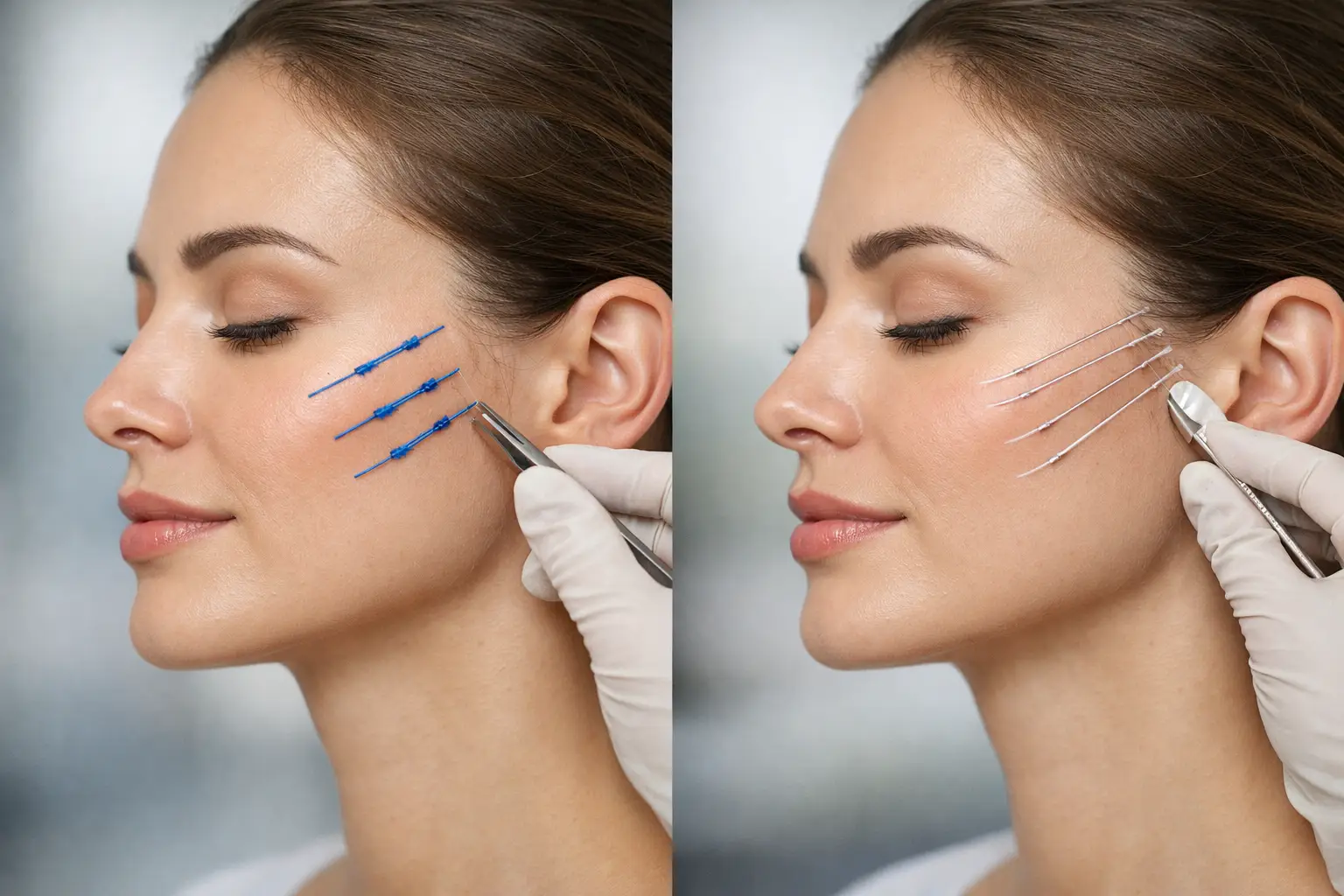
A softer jawline, early jowling, or cheeks that no longer sit where they used to can make the face look tired even when you feel your best. When comparing MINT threads vs PDO, the first thing to understand is that this is not always an either-or choice. MINT threads are made from PDO material, but their design, lifting strength, and ideal uses can be different from traditional smooth PDO threads.
For Long Island clients who want visible facial definition without surgical downtime, the right option depends on your skin quality, degree of laxity, facial anatomy, and desired result. A careful consultation matters because threads can create meaningful improvement, but they are not a substitute for a surgical facelift when skin laxity is advanced.
What Are PDO Threads?
PDO stands for polydioxanone, a biocompatible, absorbable suture material that has been used in medicine for years. In aesthetics, PDO threads are placed beneath the skin to support tissue, stimulate collagen production, and improve skin quality over time.
Not every PDO thread is intended to lift. Smooth threads are typically used in a mesh-like pattern to encourage collagen and improve fine lines, crepey texture, and mild skin laxity. Twisted or screw threads can add slightly more structure in targeted areas. Barbed or cog PDO threads are designed to engage tissue and provide a more immediate lifting effect.
That distinction is essential. When someone says they want PDO threads, they may be referring to collagen-stimulating smooth threads, lifting threads, or both. The treatment plan should match the concern, rather than applying the same thread type to every face.
MINT Threads vs PDO: The Key Difference
MINT is a branded PDO thread system known for its molded cog design. Rather than relying on cut barbs, MINT threads feature cogs that are formed into the thread. This construction is designed to provide strong tissue engagement and directional lifting for appropriate candidates.
Traditional PDO threads come in many designs, including smooth, twisted, and barbed options. Some can produce an attractive lift, while others are primarily selected for collagen stimulation. MINT threads fall within the PDO category, but they are generally chosen when a more structured lift and contour are the priority.
| Feature | MINT Threads | Traditional PDO Threads | |---|---|---| | Material | PDO | Usually PDO | | Typical purpose | Lifting and contouring | Collagen stimulation, support, or lifting depending on design | | Design | Molded cog threads | Smooth, screw, barbed, or cog designs | | Immediate change | Often noticeable after placement | Varies widely by thread type | | Common treatment areas | Cheeks, jawline, jowls, neck, brows | Fine lines, cheeks, jawline, neck, under-eye area, and more |
The comparison should not be reduced to which thread is better. The better question is which approach is more likely to create a natural, balanced result for your face.
When MINT Threads May Be the Better Choice
MINT threads are often considered for clients with mild to moderate skin laxity who want more noticeable lifting through the midface, lower face, jawline, or neck. They can be especially helpful when the goal is to improve early jowls, restore cheek support, sharpen the jawline, or create a subtle brow lift without surgery.
The appeal is the combination of immediate repositioning and longer-term collagen stimulation. You may see contour improvement right after treatment, although swelling and tissue settling can temporarily affect the early appearance. Over the following months, collagen remodeling can contribute to a firmer look.
MINT threads are not intended to pull severely loose skin tight. If there is substantial sagging, a very heavy lower face, or significant volume loss, adding volume with injectables, improving skin quality with energy-based treatments, or considering surgery may produce a more appropriate result. An ethical provider will be direct about those limits.
When Traditional PDO Threads May Make More Sense
Traditional PDO threads can be an excellent choice when the concern is more about texture and subtle firmness than a visible lift. Smooth PDO threads may be placed in areas where skin looks thin, finely lined, or crepey, such as the cheeks, neck, upper lip area, or around the eyes when appropriate.
They can also be part of a layered treatment plan. For example, a provider may use lifting threads in the lower face and smooth threads in a separate area where collagen support is the main goal. This approach can be useful for clients who want to improve overall skin quality while addressing a specific contour concern.
If you are hoping for a dramatic repositioning of the cheeks or a sharp new jawline, smooth PDO threads alone are unlikely to meet that expectation. They work gradually and subtly. For the right candidate, that subtlety can be a benefit because the improvement looks refreshed rather than obvious.
Results, Longevity, and Downtime
Both MINT and PDO threads are absorbable. The threads gradually dissolve, but the collagen response they encourage can extend the visible benefits beyond the time the thread itself remains in place. Results vary according to thread type, placement technique, skin condition, lifestyle factors, and natural aging.
With lifting threads, many clients see an immediate change, followed by a period of settling. Final results are usually evaluated after swelling resolves and the tissue has adjusted. Depending on the treatment, results may last roughly one to two years, though no provider should promise an exact duration for every patient.
Downtime is typically limited compared with surgery, but it is still real. Tenderness, swelling, bruising, tightness, and temporary unevenness can occur. Most clients can return to normal routines quickly, but may need to avoid strenuous exercise, dental procedures, aggressive facial massage, and wide mouth movements for a period recommended by their provider.
Safety Depends on More Than the Thread
Thread lifts require medical judgment, detailed facial assessment, and precise placement. The product matters, but so do the hands performing the procedure. A qualified provider should review your medical history, current medications and supplements, history of facial fillers, skin quality, and goals before recommending treatment.
Threads may not be appropriate for everyone. Active skin infection, certain autoimmune conditions, bleeding concerns, pregnancy, uncontrolled medical issues, or unrealistic expectations can change whether treatment is advisable. Risks can include bruising, infection, temporary dimpling, asymmetry, thread visibility, or discomfort. Choosing a medically supervised setting and following aftercare instructions helps reduce avoidable risks.
Should You Combine Threads With Other Treatments?
Often, the most natural result comes from treating more than one cause of facial aging. Threads address tissue support and skin stimulation, but they do not replace lost volume in every area or erase deep expression lines.
A customized plan may pair threads with carefully placed dermal filler, neuromodulators for dynamic wrinkles, microneedling, or skin-tightening treatments. The timing matters. Some treatments should be performed before threads, while others are best scheduled after healing. A personalized plan prevents overcorrection and keeps the result proportional to your features.
Choosing Your Best Thread Lift Plan
The right treatment begins with an honest assessment, not a one-size-fits-all recommendation. At Elite Laser Center, a consultation can help determine whether MINT threads, another PDO thread option, injectables, or a combined approach best fits your skin and goals.
If your priority is a more defined jawline or a lifted midface with minimal downtime, MINT threads may be worth discussing. If your goal is gradual collagen support and improved texture, traditional PDO threads may be the more suitable path. The most successful result is one that looks like you - rested, refined, and confidently natural.