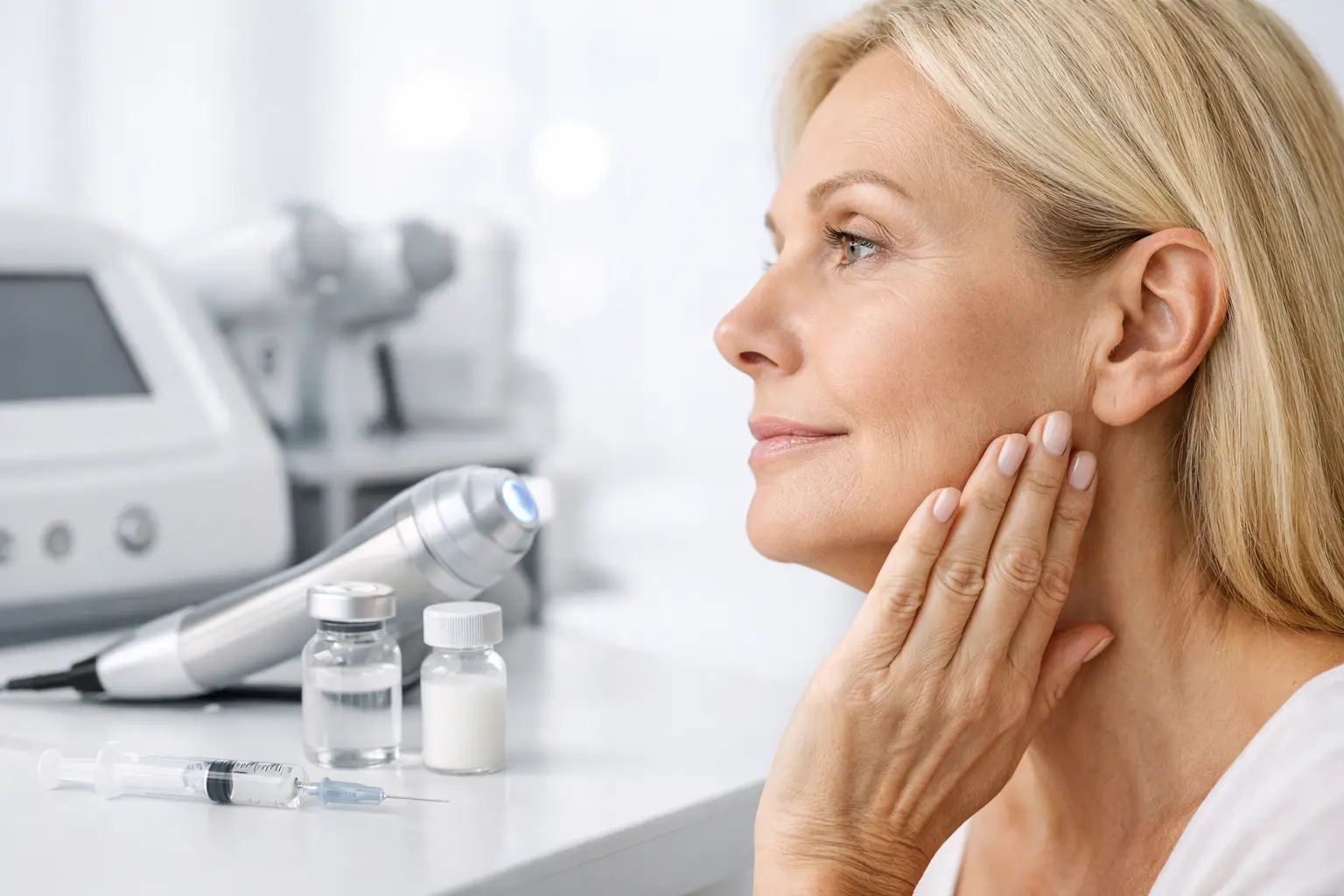
You usually notice jowls in photos first. The jawline looks softer, the lower face starts to feel heavier, and suddenly the creams that once felt promising do not seem to do much. If you are comparing the best treatments for jowls, the real question is not just what works. It is what works for your skin, your anatomy, and how much lift you actually want without surgery.
Jowls happen because several changes show up at once. Skin loses collagen and elastin, facial fat shifts downward, and the support structure under the skin becomes less firm over time. Genetics, weight changes, sun exposure, and natural aging all play a role. That is why there is no single treatment that is right for everyone. The best result usually comes from matching the treatment to the cause.
What are the best treatments for jowls?
The best treatments for jowls are usually non-surgical skin tightening, PDO or MINT threads, strategic filler placement, and in some cases neuromodulators to reduce downward pull at the corners of the mouth and jawline. For more advanced sagging, surgery may still be the strongest option, but many people can get visible improvement without going that far.
What matters most is degree of laxity. Mild jowls respond differently than moderate or more advanced skin descent. Age also matters less than people think. A person in their 40s with sun damage and volume loss may need a different plan than someone in their 60s with thicker skin and better collagen support.
Start by figuring out what is causing the jowls
If the main issue is early skin laxity, energy-based tightening treatments can be a smart first step. These work by heating the deeper layers of tissue to stimulate collagen remodeling. Results are gradual, which some people like because the change looks natural. The trade-off is that mild to moderate laxity responds best. If the tissue has dropped significantly, tightening alone may not create the definition you want.
If the problem is loss of support in the cheeks or along the jawline, filler may help more than a tightening treatment by itself. This surprises a lot of people. Jowls are not always about adding volume directly into the jowl area. In many cases, placing filler higher in the midface or around the chin and jawline creates structure that visually reduces heaviness below.
If you want more noticeable lift without surgery, threads can be a strong middle ground. They physically reposition tissue while also stimulating collagen over time. The result is more immediate than collagen-only treatments, but it is still not the same as a surgical facelift. Good candidates usually have mild to moderate sagging and want visible improvement with limited downtime.
Non-surgical skin tightening for early to moderate jowls
For people who still have decent skin quality but are starting to see looseness around the jawline, skin tightening is often one of the most sensible starting points. These treatments use controlled heat to trigger collagen production and improve firmness gradually. The biggest advantage is minimal downtime. You can usually get back to your routine quickly.
The limitation is expectations. Skin tightening does not pull skin upward the way surgery does. It improves firmness and can sharpen the lower face, but the effect is usually subtle to moderate. It tends to work best when the jowls are just starting to form or when it is used as part of a broader treatment plan.
Consistency matters here. Some patients do best with a series, followed by maintenance. If you are looking for a dramatic one-time change, this may not be your best fit.
When skin tightening makes sense
This option is strongest for mild sagging, prevention-minded patients, and people who want little to no downtime. It can also be a smart add-on after other treatments to help maintain results longer.
PDO and MINT threads for visible lift
Threads are one of the most talked-about treatments for jowls because they address something collagen stimulators cannot fully fix on their own: tissue position. PDO and MINT threads are placed under the skin to lift and support sagging areas, especially along the lower face and jawline.
For the right patient, this can create a cleaner jawline with a more defined profile. Results are typically noticeable sooner than with skin tightening alone, which is a major reason threads appeal to busy adults who want improvement without surgery and long recovery.
That said, threads are technique-sensitive. This is not a treatment where you want a rushed, one-size-fits-all approach. Proper vector placement, patient selection, and medical oversight matter. You also need realistic expectations. Threads can lift, but they do not remove excess skin. In experienced hands, they can be an excellent option for patients with mild to moderate jowling who still want a natural look.
Filler for jawline support and facial balance
Filler can be one of the best treatments for jowls when the lower face has lost structural support. The key is placement. Overfilling directly into a heavy jowl can make the area look bulkier. Strategic filler usually works better when it strengthens surrounding areas, such as the cheeks, pre-jowl sulcus, chin, or jawline.
This approach can restore shape and create cleaner transitions from the face to the neck. It also helps with facial balance, which is why some patients end up looking younger even if the amount of filler is relatively conservative.
The trade-off is that filler is not a tightening treatment. If skin laxity is the main issue, filler alone may not solve it. In some faces, too much filler can also create a heavier appearance. A careful assessment is what separates a refined result from an obvious one.
Neuromodulators can help in select cases
Botox or similar neuromodulators are not the first treatment most people think of for jowls, but they can help when downward-pulling neck or lower-face muscles are contributing to the problem. Relaxing specific muscles may soften the pull that blurs the jawline.
This tends to work best as a supporting treatment rather than the main event. If skin is loose or volume has shifted significantly, neuromodulators alone will not do enough. But in the right plan, they can improve overall lower-face definition.
Combination treatments usually give the best result
The lower face ages in layers, so treating one layer often gives only partial improvement. That is why combination plans tend to produce the most satisfying outcome. A patient might do threads for lift, skin tightening for collagen support, and filler for structure. Someone else may only need tightening plus small amounts of filler.
This is also where customized planning becomes so important. The best treatment is not always the most aggressive one. It is the one that fits your level of laxity, facial anatomy, recovery tolerance, and budget while still looking believable.
A medically supervised consultation should assess skin thickness, laxity, bone structure, fat distribution, and how much support your face has lost. That level of planning is what leads to natural, visible results instead of chasing trends or overcorrecting one area.
When surgery may be the better answer
There is a point where non-surgical options become less efficient. If you have significant jowling, loose neck skin, or pronounced tissue descent, a facelift or lower-face surgery may offer a stronger and longer-lasting result than repeated non-surgical treatments.
That does not mean non-surgical care has no place. Many patients are simply not ready for surgery, and a well-designed treatment plan can still create meaningful improvement. It does mean honesty matters. The best provider is not the one who promises surgical results from a syringe or device. It is the one who tells you what is realistically achievable.
How to choose the right provider
Jowl treatment is one of those areas where experience shows. The lower face is easy to overfill, undertreat, or treat with the wrong method entirely. You want a provider who understands facial aging as a whole, not just one device or injectable product.
Look for a practice that offers multiple options, works under medical supervision, and builds treatment plans around your anatomy rather than a preset package. If a consultation feels rushed or the answer is the same for every patient, that is a red flag. In a results-driven med spa setting, personalized planning should still come first.
For patients on Long Island who want a non-surgical approach, this is exactly where an experienced aesthetic team can make a real difference. At Elite Laser Center, the focus is on safe, effective treatments that are matched to the person in front of us, not just the area they want to fix.
What to expect from results
Most non-surgical jowl treatments improve definition rather than erase every sign of aging. That is often the goal anyway. A better jawline, less heaviness, and a fresher lower face can make you look more rested and more confident without changing how you look.
The timeline depends on the treatment. Filler can show quickly. Threads often offer an earlier lift with continued improvement over time. Skin tightening usually takes patience, since collagen remodeling is gradual. Maintenance matters too. Aging does not stop, so results need support.
The best place to start is not with the most popular treatment online. It is with a clear assessment of what your face actually needs. When the plan fits the cause, jowl treatment can be one of the most rewarding non-surgical upgrades you make.